Palm reading from a photo
Two photos of your hands — and a symbolic AI reading of the lines.
Add photos of both palms
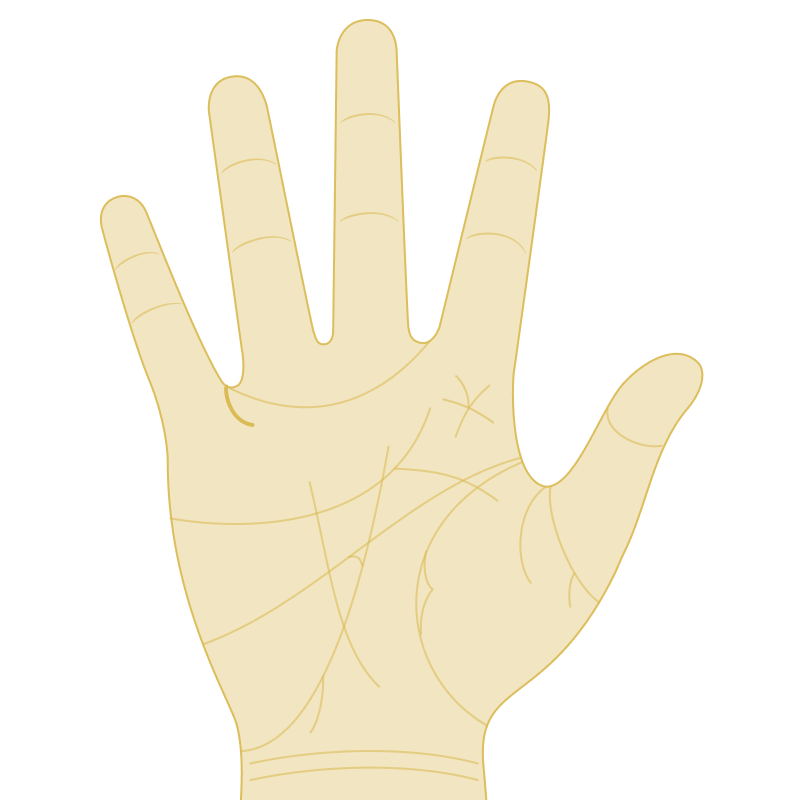 Left palm
Even light · the whole palm · no flash. How to shoot →
What would you like to know?
An overall look at the main lines and their traditional meanings.
Add both photos first. No sign-up.
How to photograph your palm
More light
Shoot by a window or in bright, even light. No flash — it blows out the centre of the palm and erases exactly the lines that need reading.
The whole palm
Open your hand, spread the fingers slightly and hold the palm flat. Both the wrist and the fingertips should be in frame.
Both hands in turn
Photograph the left and right palm as separate shots: palmistry reads them as a pair — one for what you were born with, one for what life has made of it.
Common questions about palm reading
Which hand is read — the left or the right?
In the classical tradition the left palm shows what a person arrived with: inborn tendencies and the script they were handed. The right shows what they did with it: choices, habits, changed circumstances. For left-handers the roles swap. That's why we ask for both shots: the reading is built on the comparison, and it's the divergence between the hands that says the most.
Can the life line tell you how long someone will live?
No, and this is the most common misconception about palmistry. The length of the life line has nothing to do with lifespan — it speaks of your reserve of energy, how evenly you spend it and where the turning points fell. A short but deep line reads as a strong, concentrated resource, not as a prediction of a deadline.
What does a short life line mean?
Most often that energy is spent in bursts: the person engages intensely but needs pauses to recover. It can't be read in isolation — a short life line beside a clear fate line and a pronounced mount of Venus gives a completely different picture than the same line with weak neighbours. That's why the reading is built on the combination of lines.
What does the letter M on the palm mean?
The "letter M" isn't a separate sign but a shape that forms when the life, head and heart lines cross in a characteristic way. Tradition links it with intuition, self-discipline and the knack of spotting an opportunity in time. It appears far more often than people assume, so it isn't rare in itself — what matters more is how clear the lines that form it are.
Do the lines on the hand change over time?
Yes. The major lines — life, head, heart — keep their basic pattern, but their depth, clarity and small branches shift over the years, especially after heavy strain or a change in lifestyle. So it's worth coming back to a palm reading a year or two later: the comparison with an earlier one is informative in itself.
What does a cross on the palm mean?
It depends on where the cross sits. On the mount of Jupiter tradition reads it as a sign of a strong union, between the head and heart lines as a symbol of inner searching, and on the life line itself as a mark of a sharp change. A single small cross is almost never read as something bad: its surroundings give it meaning.
How should I photograph my palm?
You need bright, diffuse light — best of all by a window and without flash, which blows out the centre of the palm. Open your hand, spread the fingers slightly and shoot from above so that both the wrist and the fingertips are in frame. The larger and sharper the shot, the more detail can be made out.
How accurate is an online palm reading?
The AI works through the same landmarks a practising palmist does: the pattern and depth of the lines, the mounts, the shape of the palm and fingers — and it names what it sees in your shots rather than generalities. That said, palmistry remains a symbolic tradition, not a forecasting method: a reading works well as a prompt to think about yourself, not as a verdict or a set of instructions.
Do I need to register?
No. A palm reading is available straight away: free ✦ are credited every day and they're enough for a reading. Registration is only needed to keep a history of your readings and to unlock the larger topics such as the full spread.
How much does a reading cost?
The general topic and "family and love" are 2 ✦ each, work and health 3 ✦ each, and the full spread across every area is 7 ✦. The daily free stars cover a first reading; after that ✦ can be topped up with a package from 50 ₽.
Palmistry guide
What the lines on your hand mean
Every line has its place in the tradition. Open a section — the explanation appears right here.
Palmistry: what is read in a hand
Classical palmistry rests on reading a few key lines on the palm, and our AI works through exactly the same landmarks a practising palmist would. The life line — its length, depth and breaks — speaks of vital energy, resources and turning points, and not at all of the number of years lived, as people sometimes assume. The heart line is about feelings, relationships and how a person shows emotion. The head line is about the cast of the mind, logic and the way decisions get made. The fate line, where it is pronounced, is about a sense of purpose and stability in life.
Reading the lines of the hand never comes down to one line in isolation from the rest: a palmist reads their combination — a deep life line alongside a weak head line, for instance, says something quite different from both lines being equally strong. That's why a short answer of the form "line N means X" is nearly always an oversimplification: the AI on this site reads the lines together rather than one by one.
The life line
The life line is the arc that curves around the base of the thumb and the mount of Venus. It is the best known line and the most often misunderstood: its length has nothing to do with lifespan. What palmistry reads in it is your reserve of vital energy, your resistance to strain and how evenly you spend that energy.
A deep, clear life line speaks of a solid reserve and the ability to recover. A pale or thin one says strength drains faster than it is replenished, and that routine matters more for such a person than for others. Breaks are traditionally read not as misfortune but as turning points: a move, a change of profession, a major shift in how someone lives. If the line runs more confidently after the break, the turn did them good.
A wide arc reaching far from the thumb is a sign of openness and a pull towards movement; a line pressed close to the thumb is more common in cautious, home-loving people.
The heart line: feeling and relationships
The heart line runs beneath the bases of the fingers, from the edge of the palm towards the index finger. From it palmistry judges how a person feels and how they show those feelings — and the two are far from the same thing.
A long line reaching the index finger speaks of high expectations of those close to you and of loyalty to the person you have chosen. A short one says the feelings are strong but hard to put into words. A clear, even line reads as emotional steadiness, while many small branches rising upward read as responsiveness and an ease in forming attachments; branches falling downward are traditionally linked with disappointments carried for a long time.
The small cross-strokes at the edge of the palm above the heart line are traditionally called relationship lines, or marriage lines. Counting unions by them is an oversimplification: they speak of significant attachments rather than of stamps in a passport.
The head line: the cast of the mind
The head line, also called the line of the mind, runs across the middle of the palm and shows not the level of intelligence but its cast: how a person thinks, what they lean on when deciding and how readily they change their mind.
A straight line is about concreteness, logic and a practical approach. One curving markedly downward, towards the mount of the Moon, is about imagery, imagination and an interest in what cannot be touched. A long line speaks of a tendency to think everything through to the end, a short one of quick decisions and trust in a first impression.
The start of the line matters too. If it merges with the life line at the beginning, the person takes a long time adjusting to change and is cautious in their choices. If it separates immediately, independence showed itself early. A forked end — the "writer's fork" — is traditionally read as the ability to see a situation from two sides at once.
The fate line
The fate line rises from the base of the palm towards the middle finger. Not everyone has one, and its absence means nothing bad: tradition links this line with a sense of a set path rather than with success as such.
A clear fate line speaks of an early understanding of your direction and of an inner support that holds a person through difficult periods. A broken one speaks of a path assembled from several distinct stages: such people change profession more often, and each time not out of failure but because the previous stage had run its course. A line beginning high, closer to the middle of the palm, is a common sign that a person found their own thing later, closer to maturity.
Where the line starts is read as well: from the mount of the Moon it speaks of a path that depends heavily on other people and circumstances; from the life line, of work done with one's own hands.
Mounts and the shape of the hand
Besides the lines, palmistry looks at the mounts of the palm — the raised areas at the base of the fingers and on the wrist, named after the planets: Venus, the Moon, Jupiter and others. Each mount answers for its own trait: a developed mount of Venus is about sensuality and one's attitude to those close by, the mount of Jupiter about ambition and leadership. The shape of the hand overall — square, conic, spatulate — and the length of the fingers fill out the picture, which is why a full reading of the lines takes into account not only their pattern but the geometry of the palm as a whole.
Signs on the palm: cross, star, triangle
Besides the lines, palmistry reads the small figures that form at their crossings and on the mounts. The presence of a sign decides nothing in itself — its place and how clear it is give it meaning.
A cross traditionally marks a point of choice or change; on the mount of Jupiter it is read as a sign of a strong union, and between the head and heart lines as a symbol of inner searching. A star is the sign of a vivid but brief event: a stroke of luck, a meeting, a sharp turn. A triangle is considered a favourable figure and speaks of an ability that seems to come to a person of its own accord. A grille, by contrast, reads as stagnation in whatever the mount answers for — a signal that energy is being spent to no purpose.
Islands are looked at separately — small loops sitting right on a line. Tradition links them with a period in which a person seems split between two options, and after which the line usually returns to its former clarity.
Left and right hand: the difference
A palm reading is always built on comparing two hands. The passive hand — the left for a right-hander — shows what was given at birth: inborn tendencies, the family script, the starting data. The active, working hand shows what the person did with it: real experience, choices, changed circumstances. For left-handers the roles mirror.
The most interesting part is not the lines themselves but the divergence between the hands. If the pattern is almost identical, the person lives close to their original script. If the palms differ noticeably, they have rebuilt a great deal in themselves — and palmistry reads that as a sign of strong will, not as a deviation from some "correct" path.
That is exactly why we ask for photographs of both palms: from one hand the reading comes out half as rich, because there is nothing to compare it against.
How a reading from a photo works
Palmistry from a photo works as attentively as an in-person session: photograph both palms in good light — one is taken as "given at birth", the other reflects what has taken shape under the influence of a life lived — and the AI will carry out the reading online, naming specific features in your photo rather than general phrases that would suit anyone. This is a free palm reading with no registration: the result is a detailed interpretation of 1,000–1,500 characters on your chosen topic — general, family and love, work, health, or the full spread across every area at once.
Guides to the lines and signs
In-depth articles on what is read in a palm — from the life line to the signs on the mounts.
Other readings and forecasts
The portal has 50 tools — from tarot and runes to a full natal chart. See what else they can tell you.